This year (2024) marks 200 years since the founding of the RNLI. Have a flick (or a scroll for the more tech minded) through any Masonic news letter or magazine in the UK and you’ll almost certainly find an article about a recent donation to the Institution. But why? What is the connection between these two, seemingly, very different organizations and where did it come from? W/Bro Piers Hallihan explores some of the history.
The unique circumstances of the presentation of the ”Duchess of Kent”, in 1982 caused some amusement. In his capacity as Grand Master, the Duke of Kent, presented himself, as President of the RNLI, with a new Arun Class Lifeboat, named after his wife.
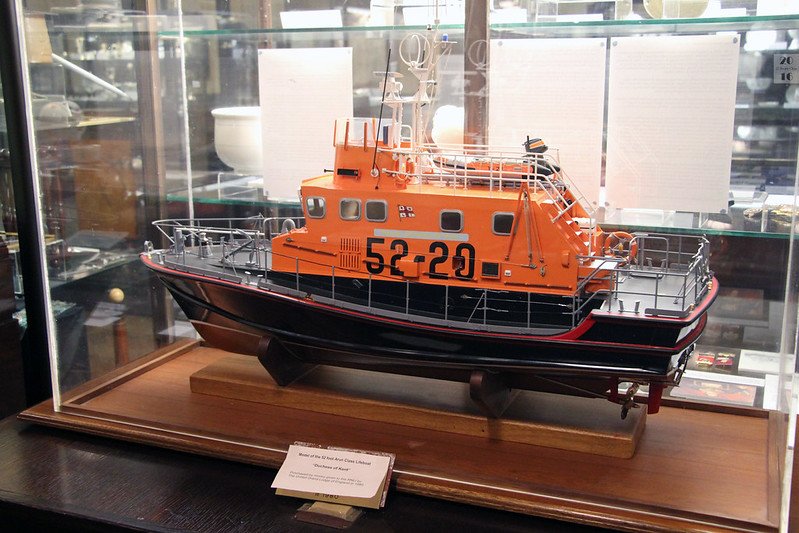
Model of RNLB Duchess of Kent - Geoff Henson - Flickr
Other names are less obvious and demand a little more research.
Lady Leigh, for example, launched in 1872 was named for the wife of Lord Leigh, the PGM for Warwickshire and was purchased to celebrate the occasion of his 20th year in that role.
Although only “Mark Mason”, a Tamar Class “All Weather” boat serving the rugged coast of Pembrokeshire is the only overtly Masonic named lifeboat currently in service, there is little doubt that a determined trawl through the names of the 448 Lifeboats and Hovercraft currently operating around the coasts of the UK and Ireland would reveal some Masonic connections.
It is these individual links that are important to the relationship between UGLE and the RNLI. No organisation makes a connection to a charity without first being driven by a motivated individual. That individual connection to the task of saving lives at sea goes back much further than the 150 years since the first published appeal. It even goes back beyond the 200 years of the RNLI’s existence.
Although coastal communities had been using their own craft to rescue each other as long as they had been seafaring, it was in 1789 that the first purpose-built lifeboat came into being. After the tragic sinking of the “Adventure” with all hands at within sight of the shore in the mouth of the River Tyne, the Law House Committee in South Shields launched a competition to design a lifeboat capable of operating in the kind of storm that had claimed “Adventure”. Two designers were asked to share the reward of 2 guineas after the Committee chose to combine elements from both of their entries into the final design. One of them, William Wouldhave, took offence at only being offered half of the prize and rejected it entirely. The second, Boat builder Henry Greathead, who was initiated into the St Bede’s Lodge, Morpeth, Northumberland, in 1786, took on the task of building the boat based on the amalgamated design and subsequently became known as the inventor of the lifeboat. One of the 31 boats of this type built by Greathead, the “Zetland”, built in 1802 still survives and is the main exhibit at the Zetland museum in Redcar, Northumberland.
Whilst the authorities in ports and coast towns around Britain worked independently to rescue those whose vessels foundered, one man had the vision of a national service. Sir William Hillary initially took his proposal for the formation of a “National Institution for the Preservation of Lives and Property from Shipwreck” to the Admiralty who refused to help. He then took a slightly rebranded appeal to London. More specifically, he took it to the various philanthropic societies of London.
On the 4th of March 1824, at Bishopsgates’ London Tavern, Hillary chaired a meeting of over 30 gentlemen of London – the inaugural meeting of what was later to be named the Royal National Lifeboat Institution.
A number of eminent Masons put their names to the founding of the Institution. The Patronage of King George IV who, as Prince of Wales, had served as Grand Master of the Premier Grand Lodge of England, ensured that many other prominent London gentleman also added their names.
The Chairman of the West Indies Merchants and Whig MP, George Hibbert, a member of the Shakespear Lodge, no 99 in Covent Garden, would have wielded considerable influence in any campaign, as would Baron Nathan Rothschild, a banker and initiate of the Lodge of Emulation, No 12 at the time, now No 21.
George Palmer, the MP for South Essex, had been initiated in 1822 into the Lodge of Antiquity in Portsea, Hampshire (No 28 at the time, later No 26 and erased in 1838). He joined the RNLI in 1826 and later became the Deputy Chair of the Institution, a post he held for a quarter of a century.
As well as being involved in the design of lifeboats, Palmer was instrumental in securing further noble patronage for the institution. He played a large part in getting the 4th Duke of Northumberland appointed as President in 1854. The 6th Duke of Northumberland became president in 1866 and was initiated into the Northern Counties Lodge, No 406, in Northumberland in 1870.
According to the 2022 Financial report, around 60% of the Institution’s income is derived from wills and legacies. This totalled just over £140M in 2022. One particular legacy stands out in RNLI History though.
In 1894, a bequest of £50,000 was received from the estate of one, James Stevens, a timber merchant from Birmingham. Very little is known about this individual. He had no overt connection to the RNLI prior to his death but he had a huge impact. £50,000 in 1894 is equivalent to almost £5.5M in todays money and his legacy funded the building of 20 new lifeboats. These boats gave 37 years of service, the final one being taken out of service in 1933.
Records show that, at the time of his death, Stevens was a member of London’s Reform Club – this was the residence listed at his Probate hearing. It is known that he joined the Reform Club, situated on Pall Mall, in 1862 and remained a member until his death in 1893. It seems reasonable to assume that he would have interacted with a number of philanthropically inclined members of London Society. A James Stevens is shown in UGLE records to have joined a number of London Lodges in 1863, including the Robert Burns Lodge which met at Freemason’s Hall. It is highly likely that Stevens would have come into contact with members of the Lodge of Faith, the first official Masonic donors to the RNLI, who met in the same venue. It is a given that he would have been aware of the fundraising appeal published in “The Freemason” during that era but it is unclear what personal connection inclined him to bequeath almost half of his significant estate.
Whilst campaigns and appeals have been running all over the country to fund the provision of Lifeboat services, either through funding newly built boats or simply by raising funds to meet the day- to-day costs and support volunteer crews all over the British Isles, UGLE have also been able to respond directly to crises within the Service.
In 1981, the Freemasons’ Grand Charity was established. Whilst the Charity’s core function has been to make donations to other charities and support Freemasons in distress, the Charity also has the ability to make emergency grants. One of the first significant disaster grants was made just a few months after the establishment of the charity when, in December 1981 the Penlee Lifeboat, “Solomon Browne” was lost with all hands. This grant helped to enable continuation of lifesaving cover on the Cornish coast, thanks in no small part to the fortitude of the residents of Mousehole who, within 24 hours of the loss had volunteered enough people to form a new crew.
It is clear that there is more than just a connection between Freemasonry and the RNLI. From the design and build of the first purpose built lifeboat, through the birth of the Institution in the philanthropic societies of London, the phenomenal amount of funding raised at every level, from campaigns such as the Province of Essex’s “Orange Aid” and the contributions of private Lodges and individuals, to the current position where we share a ruling Grand Master and President, the history of the two organisations are inextricably linked. It is a link that both can be proud of.